Step 1: Prepare the Spinach
Place the spinach in a large non-stick frying pan over medium heat.
Cook for 2–3 minutes until wilted, stirring occasionally.
Transfer to a sieve and allow to cool slightly.
Squeeze out as much excess moisture as possible.
Finely chop the spinach and set aside.
Removing excess water helps prevent the stuffing from making the turkey soggy.
Step 2: Cook the Mushroom Filling
Heat the olive oil in the same frying pan.
Add the diced onion and cook for approximately 4 minutes, until softened.
Stir in the garlic and cook for another 30 seconds.
Add the chopped mushrooms.
Cook for 6–8 minutes, stirring occasionally, until the mushrooms have released their moisture and the pan is nearly dry.
Stir in the thyme, rosemary, paprika and black pepper.
Remove from the heat.
Step 3: Finish the Stuffing
Add the chopped spinach to the mushroom mixture.
Stir in the dried cranberries and optional walnuts.
Mix until evenly combined.
Taste and adjust the seasoning.
Allow the stuffing to cool completely before filling the turkey.
Step 4: Prepare the Turkey Breast
Preheat the oven to 190°C (170°C fan), or 375°F.
Place the butterflied turkey breast between two sheets of baking parchment.
Gently pound any thicker areas with a meat mallet or rolling pin until the meat is approximately 1.5–2cm thick.
Try to create an even rectangle.
Season both sides lightly with salt and black pepper.
Step 5: Fill and Roll the Turkey
Lay the turkey breast flat on a clean work surface.
Spread the cooled spinach and mushroom stuffing evenly over the surface, leaving a 2cm border around the edges.
Starting from one long side, roll the turkey tightly into a log.
Tuck in any loose edges as you roll.
Secure the roulade with kitchen-safe cooking twine at approximately 3cm intervals.
The stuffing should remain enclosed inside the turkey.
Step 6: Roast the Stuffed Turkey
Place the turkey roulade seam-side down in a lightly greased roasting dish.
Mist the surface with low-calorie cooking spray.
Season with a little additional black pepper and rosemary.
Roast for approximately 60–80 minutes, depending on the thickness of the roulade.
If the surface begins browning too quickly, loosely cover it with foil.
Important: Check the centre of the stuffed roulade with a food thermometer. The turkey and the centre of the stuffing must reach at least 74°C (165°F). Cooking time alone is not a reliable indicator.
Step 7: Rest the Turkey
Remove the cooked turkey from the oven.
Transfer it to a clean board.
Cover loosely with foil and allow to rest for approximately 15 minutes.
Resting helps the meat retain its juices and makes slicing easier.
Step 8: Make the Light Gravy
While the turkey rests, place the chopped shallot and a splash of stock in a small saucepan.
Cook gently for 3–4 minutes until softened.
Add the remaining stock and any suitable defatted roasting juices.
Stir in the Dijon mustard, if using.
Simmer for approximately 5 minutes.
Mix the cornflour with the cold water until smooth.
Gradually stir the mixture into the simmering gravy.
Cook for another 1–2 minutes, until lightly thickened.
Season with black pepper.
Step 9: Slice and Serve
Carefully remove the cooking twine from the turkey roulade.
Using a sharp knife, cut into slices approximately 2cm thick.
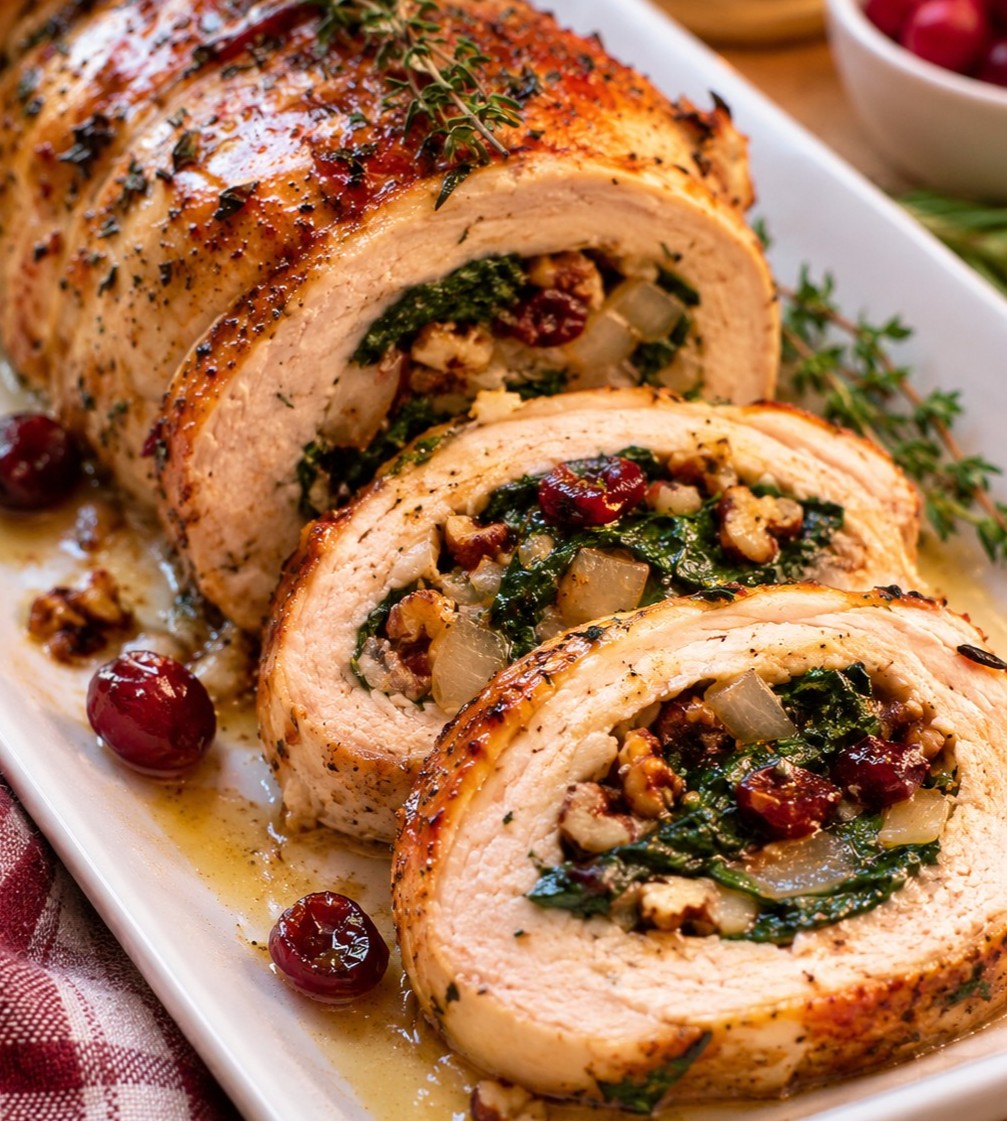
Arrange the slices on a large serving platter, slightly overlapping them to show the colourful spinach and mushroom filling.
Spoon a little warm gravy around the turkey.
Garnish with fresh rosemary and thyme.
Serve the remaining gravy separately.
Tips for the Best Stuffed Turkey Roulade
Use an Evenly Butterflied Turkey Breast
An even thickness makes the turkey easier to roll and helps it cook more uniformly.
Remove Moisture from the Filling
Both spinach and mushrooms contain plenty of water. Cooking the mushrooms until nearly dry and squeezing the spinach thoroughly helps keep the filling together.
Cool the Filling Before Rolling
Hot stuffing can make the raw turkey difficult to handle and may affect food safety during preparation.
Don’t Overfill the Turkey
Leave a small border around the edges to prevent the stuffing from spilling out.
Tie the Roulade Securely
Cooking twine helps maintain a neat shape during roasting.
Use a Meat Thermometer
The safest way to check doneness is to measure the internal temperature of both the meat and the centre of the stuffing.
Rest Before Slicing
Allow the turkey to rest for 15 minutes to help preserve its moisture.
What to Serve with Stuffed Turkey Breast
This festive turkey roulade pairs beautifully with:
- Roasted carrots and parsnips
- Steamed Brussels sprouts
- Garlic green beans
- Mashed potatoes
- Roasted baby potatoes
- Braised red cabbage
- Light homemade gravy
For a colourful Christmas plate, serve a few turkey slices alongside roasted vegetables and a spoonful of gravy.
Easy Variations
Spinach and Mushroom Turkey Roulade
Leave out the cranberries and walnuts for a simpler savoury stuffing.
Cranberry and Herb Stuffed Turkey
Increase the cranberry flavour slightly and add extra fresh thyme.
Garlic and Herb Turkey Breast
Use parsley, rosemary, thyme and garlic for a classic herb-based filling.
Chicken Breast Roulade
For smaller portions, use butterflied chicken breasts. Cooking times will be shorter, so check that the centre reaches 74°C (165°F).
Nut-Free Stuffed Turkey
Omit the walnuts entirely. The spinach and mushroom filling will still provide plenty of flavour.
How to Store and Reheat
Refrigeration
Allow leftovers to cool promptly and refrigerate within 2 hours of cooking.
Store in an airtight container in the refrigerator for up to 3–4 days.
Freezing
Freeze fully cooked, cooled turkey slices in an airtight freezer-safe container for up to 2–3 months for best quality.
Thaw overnight in the refrigerator.
Reheating
Place the turkey slices in an oven-safe dish with a splash of stock.
Cover with foil and heat until thoroughly hot, reaching 74°C (165°F) in the centre.
Avoid prolonged reheating, as lean turkey breast can become dry.
Frequently Asked Questions
Can I Make Stuffed Turkey Breast Ahead of Time?
Yes. You can cook the vegetable filling ahead and refrigerate it separately. Assemble the turkey shortly before roasting, or refrigerate the assembled roulade promptly and cook it within 24 hours.
Can I Use Chicken Instead of Turkey?
Yes. Butterflied chicken breasts can be filled and rolled in a similar way, although their smaller size and shorter cooking time will require adjustments.
Do I Need to Add Breadcrumbs?
No. This recipe uses a vegetable-based filling without breadcrumbs.
Can I Leave Out the Walnuts?
Absolutely. The walnuts are optional.
Can I Make This Recipe Without Cranberries?
Yes. The cranberries provide a little sweetness, but the recipe works well without them.
Why Is My Turkey Roulade Dry?
Overcooking is a common cause. Use a food thermometer and avoid roasting the turkey longer than necessary.
How Do I Stop the Stuffing from Falling Out?
Avoid overfilling, leave a border around the edges and secure the roulade firmly with cooking twine.
Can I Serve This for Christmas Dinner?
Yes. Its festive presentation makes it an excellent centrepiece for Christmas dinner or a special Sunday roast.
Final Thoughts
This Healthy Stuffed Turkey Breast with Spinach and Mushrooms is a delicious way to serve a festive roast without pork, bacon or heavy stuffing.
The combination of tender turkey, savoury mushrooms, spinach, herbs and a touch of cranberry creates a colourful dish that looks beautiful when sliced.
Serve with roasted vegetables and a little homemade gravy for a comforting Christmas dinner that the whole family can enjoy.